In Which Direction Must The Lens Move To Focus On This Second Object - Okay, so again, to simplify, we have this photographer responding his camera to the first object here. This will give you 6 sets of data points.

Thin Lens Sign Conventions Article Khan Academy
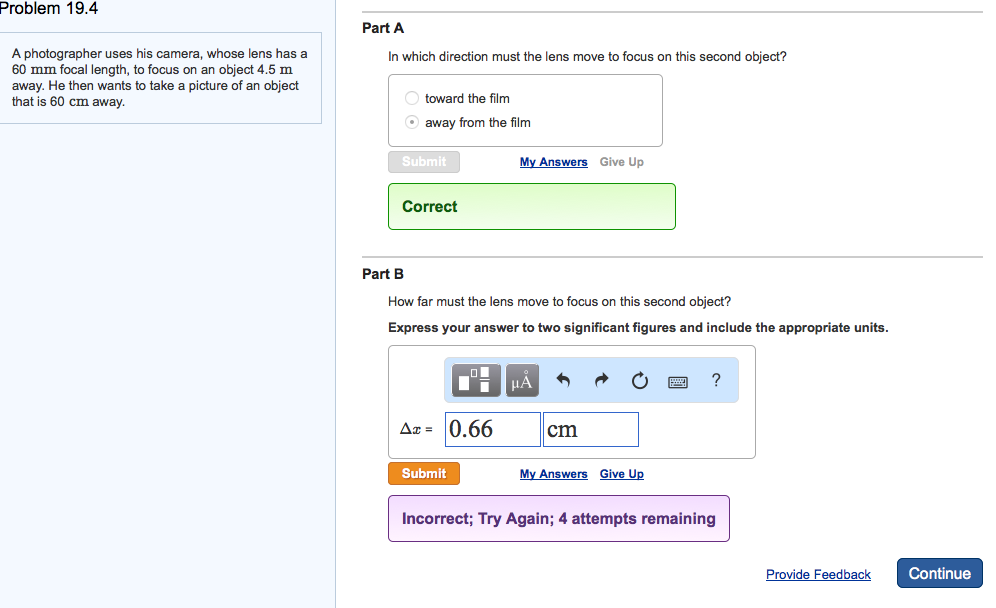
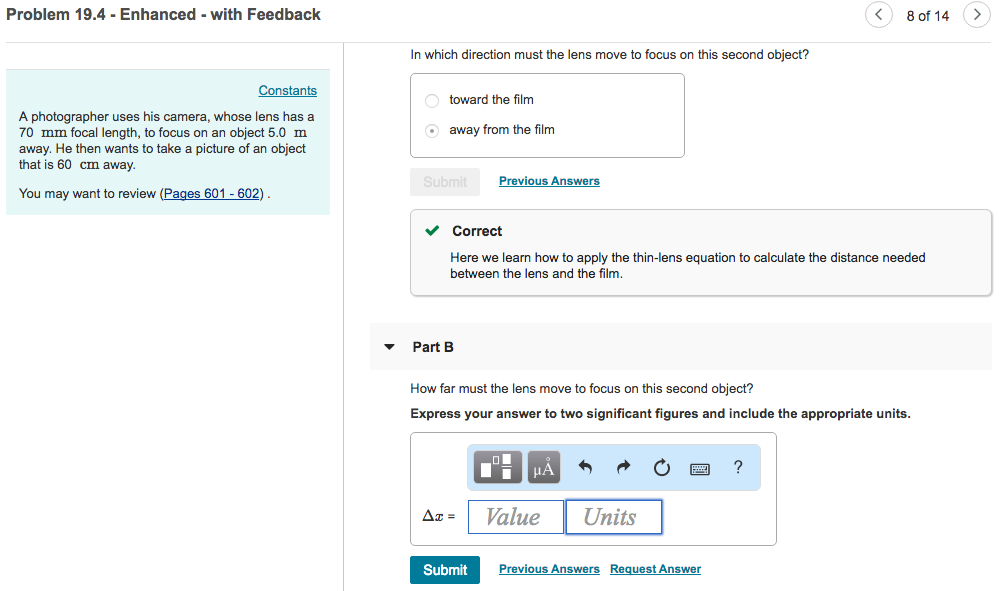
In which direction must the lens move to focus on this second object?

In which direction must the lens move to focus on this second object. Therefore the focal the focus off their lands must change. Ray diagrams for such lenses are drawn using: A) it does not make any difference.
Physics q&a library a photographer uses his camera, whose lens has a 70 mm focal length, to focus on an object 4.5 m away. Repeat parts b and d for this position of the screen and for 4 other intermediate positions of the screen. The longer the focal length of the lens, the more movement becomes apparent.
0 2 0 0 0 ) the lens must be moved away from the film by distance d = q 2 − q 1 = 2. In the second diagram, the object is 20 cm from the lens and an image is produced 20 cm beyond the lens. This is the final image produced by the combination of lenses.
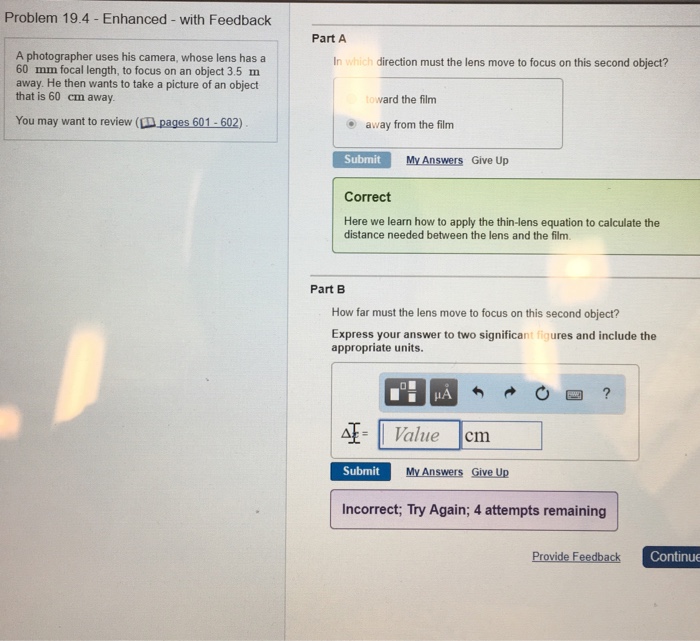
He then wants to take a picture of an object that is 60 cm away. Because light is reflected from the mirror and does not pass through a lens, the. In what direction does the image move?
Therefore, in order to keep the object in focus, the octopus must move its lens farther from its retina. A ray from the top of the object through the middle of the lens; This changes the distance from the lens to the retina and brings an object into focus.
If an object moves closer to an octopus, the image produced by the lens will be farther behind the lens. In which directuon must the lens move to focus on this second object?b.how far must the lens move to focus on this second object? A swell will be in the words of that which is while there were 65 minutes one over 2000 in worse of that, it was 67.18 so this comes out to be 65.218 standing me dinner so the lens must be moved away and the distance will be que tu minus key one equals 0.218 centimeter equals to going to 18
A second converging lens, this one having a focal length of 60.0 cmcm , is located 300 cmcm to the right of the first lens along the same optic axis part b part complete i 1 is now the object for the second lens. When an object is placed behind the center of curvature, the real image is formed between the center of curvature and focus. This means the slide should be in focus (or nearly so) at the higher magnifications once you have properly focused.
However, the distance of the closest object he can see clearly must have its image located 18 cm from his eye (q = −18 cm). This means that decreasing the object distance will increase the image distance. The size of the image is much smaller than that of the object.
Move the slide to the left. Using the lens equation, we get 1/p − 1/18 = −1/32, or p = 41 cm as the distance of the closest object he can see clearly. The third ray passes through the nearer focal point on its way into the lens and leaves the lens parallel to.
To properly focus image of the distance object, the lens must be at distance equal to the focal length from the film for closer object, 2 0 0 0 1 + q 2 1 = 6 5 1 q 2 = (6 3. Find the location and height of the image produced by the second lens. When an object is placed at infinity, the real image is formed at the focus.
Most laboratory microscopes are parfocal. Lens, the lens equation is the same but the value of fis nownegative. The focal length of the lens of a simple digital camera is 40 mm, and it is originally focused on a person 25 m away.
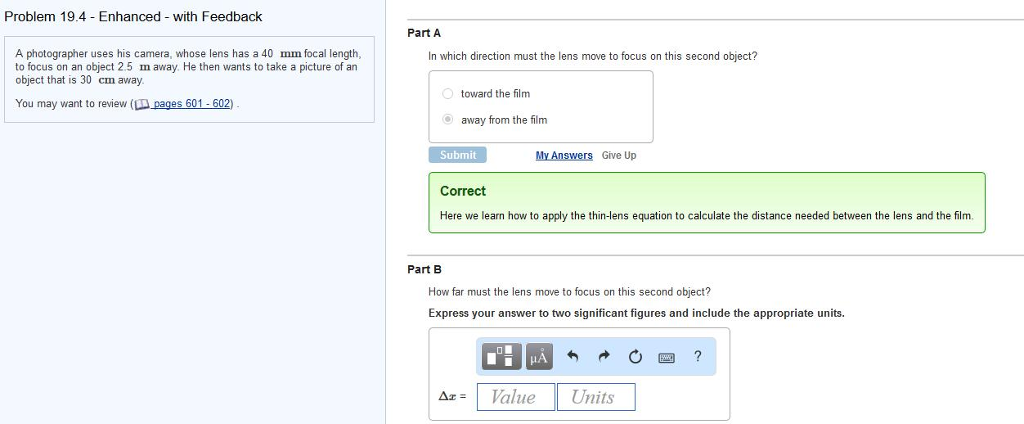
He then wants to take a picture of an object that is 30 cm away. Then he wants to take a picture off this second object here. (b) the correct explanation is option (ii).
How far must the lens move to focus on this second object? For example, 1/250 second or faster with a 200mm lens. How far must the lens move to focus on this second object?
So the lens must be moved away from the film. A photographer uses his camera, whose lens has a 50 mm focal length, to focus on an object 1.5 m away. Then move the screen a few centimeters further away from the object.
Longer lenses magnify objects on the film—and camera movement too. He must move the lens to focus on the second object. A photographer uses his camera, whose lens has a 70 mm focal length, to focus on an object3.0 m away.
A camera creates an image by focusing light from a lens onto a flat ccd array behind the lens. If you are hand holding a camera, use a shutter speed faster than the focal length of the lens: Away from the film when glasses (or contact lenses) are used to correct nearsightedness, where should the corrective lens form an image of an object located at infinity in order for the eye to form a clear image of that object?
In what direction must the lens be moved to change the focus of the camera to a person 4.0 m away? B) sideways from the ccd sensors c) away from the ccd sensors d) towards the ccd sensors Express your answer to two significant figures and include the appropriate units.
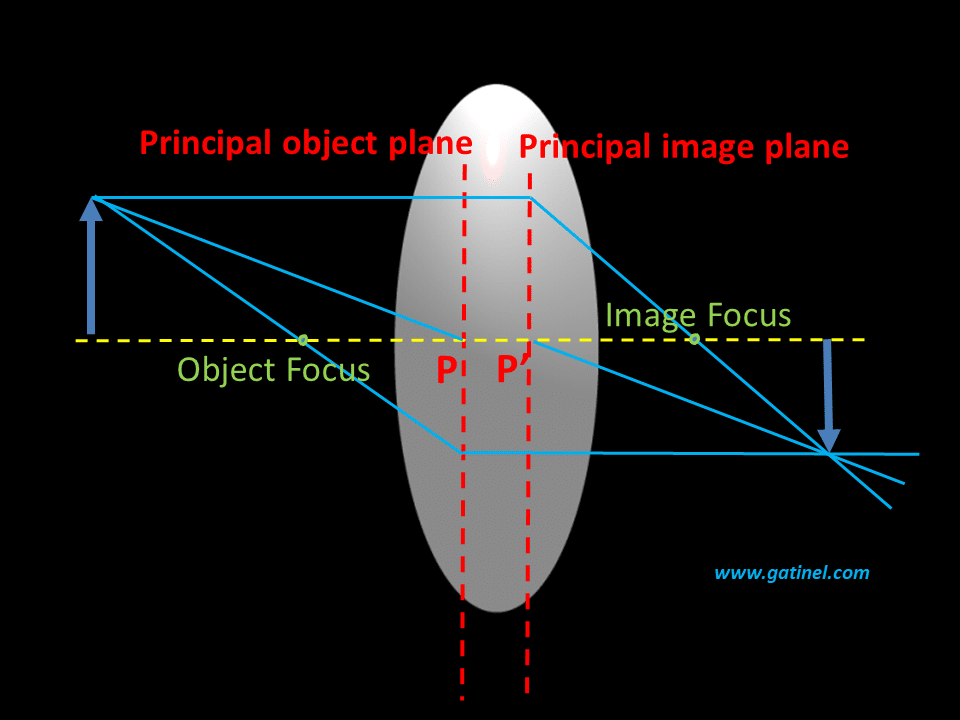
The second ray passes through the center of the lens without changing direction (rule 3). The size of the image is the same as compared to that of the object. A convex lens curves outward and bends light in the direction of a focal point and it is used in things like eyeglasses and microscopes.
He then wants to take a picture of an object that is 50 cm away. Move the screen toward the object until you can no longer find two positions of the lens where the image will focus. He then wants to take a picture of an object that is 50 cm away.
In which directuon must the lens move to focus on this second object?b.how far must the lens move to focus on this second object? And the problem wants to know how far and in which direction that he must. Without touching the focusing knobs, increase the.
In which direction must the lens move to focus on this second object? A ray from the top of the object parallel to the principal axis which the lens refracts so it seems to come from the focal point. Control knobs located just behind and underneath the condenser control the up and down movement of the condenser.
0) (2 0 0 0 − 6 5.
Shoot Now Focus Later Multi-view Lens Patent Is Sonys Latest Foray In To Light Field Photography Digital Photography Review

Presbyopia Treatments By Mechanism Of Action Opth
Solved A Photographer Uses His Camera Whose Lens Has A 60mm Cheggcom
Common Problem-g6plus-feiyutech
5 Principal Planes Explanations - Docteur Damien Gatinel

Depth Of Field And Depth Of Focus Edmund Optics
Solved Problem 194 - Enhanced- With Feedback 8 Of 14 In Cheggcom
All About Autofocus - Canon Europe
Solved A Photographer Uses His Camera Whose Lens Has A 60 Cheggcom
Large Area Liquid Crystal Lenses For Correction Of Presbyopia

Lenses Boundless Physics
Solved A Photographer Uses His Camera Whose Lens Has A Cheggcom
5 Principal Planes Explanations - Docteur Damien Gatinel
5 Principal Planes Explanations - Docteur Damien Gatinel
